

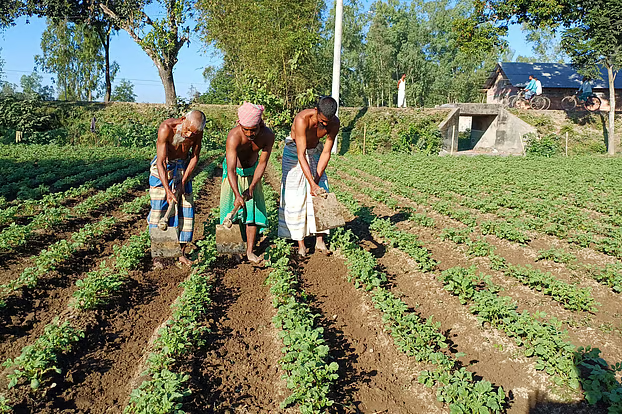
Bangladesh has witnessed a significant increase in agricultural and rural loan disbursement over the past year. However, the growth in loan defaults has far outpaced the rise in lending, with defaulted agricultural loans soaring by nearly 193 percent during the period.
According to the latest updated report from the Agricultural Credit Department of Bangladesh Bank, released in May, the sharp increase in defaulted loans is largely linked to the central bank’s revised loan classification policy.
Data from Bangladesh Bank show that total defaulted loans in the agricultural sector stood at Tk 6,881 crore at the end of May 2025. By the end of May 2026, the figure had jumped to Tk 20,130 crore, marking an increase of approximately 192.55 percent within a year.
Agriculture remains a cornerstone of Bangladesh’s economy, contributing around 11.71 percent to the country’s Gross Domestic Product (GDP) and providing employment to nearly 46 percent of the workforce. Given its importance for economic stability and food security, the government has consistently encouraged agricultural lending.
Earlier this year, shortly after assuming office, the BNP-led government announced a waiver of agricultural loans of up to Tk 10,000, including interest, for farmers engaged in crop cultivation, fisheries, and livestock farming. Despite the initiative, default levels in the sector have continued to rise sharply.
State-Owned Specialized Banks Face the Largest Increase
The highest rise in defaulted agricultural loans was recorded among state-owned specialized institutions, particularly Bangladesh Krishi Bank and Rajshahi Krishi Unnayan Bank. These banks account for nearly 65 percent of all defaulted agricultural loans in the country.
At the end of May 2025, defaulted agricultural loans at specialized banks totaled Tk 2,676 crore. Within a year, that amount surged by 393 percent to Tk 13,185 crore.
Meanwhile, state-owned commercial banks also experienced a notable increase. Their defaulted agricultural loans rose by 66 percent, reaching Tk 5,146 crore, compared with Tk 3,099 crore a year earlier.
Islamic banks recorded a 164 percent rise in agricultural loan defaults, bringing the total to Tk 939 crore by May 2026. Other private commercial banks saw a comparatively modest increase of 14 percent, with defaults reaching Tk 860 crore. Foreign banks reported no defaulted agricultural loans during the period.
New Classification Rules Drive Default Growth
Bangladesh Bank attributed the unusual rise in non-performing agricultural loans primarily to a revised loan classification and provisioning framework introduced in November 2024.
Under the updated policy, any loan installment or full repayment becomes overdue immediately after the due date passes. Loans are then categorized as regular or defaulted based on the duration of the overdue period.
The stricter repayment standards, aligned more closely with international banking practices, have reduced grace periods and tightened classification requirements. As a result, a large number of agricultural loans have been reclassified as defaulted loans within a short period.
Loan Disbursement Exceeds 97 Percent of Target
Despite the rise in defaults, agricultural lending continued to expand. Bangladesh Bank had set a target of Tk 39,000 crore in agricultural and rural credit disbursement through 58 banks during the current fiscal year.
By the end of May, covering the first 11 months of the fiscal year, banks had disbursed approximately Tk 38,077 crore, achieving nearly 98 percent of the annual target.
In addition, the Bangladesh Rural Development Board (BRDB) distributed Tk 1,176 crore in agricultural loans. Combined lending by banks and BRDB reached Tk 39,253 crore by May.
During the same period of the previous fiscal year, total agricultural loan disbursement stood at Tk 33,461 crore. This indicates a year-on-year increase of around 17 percent.
Central bank data further reveal that the highest monthly agricultural loan disbursement occurred in December, when banks distributed Tk 4,915 crore. Although lending slowed somewhat in January and February, it regained momentum during April and May, reflecting continued demand for agricultural financing across the country.


