

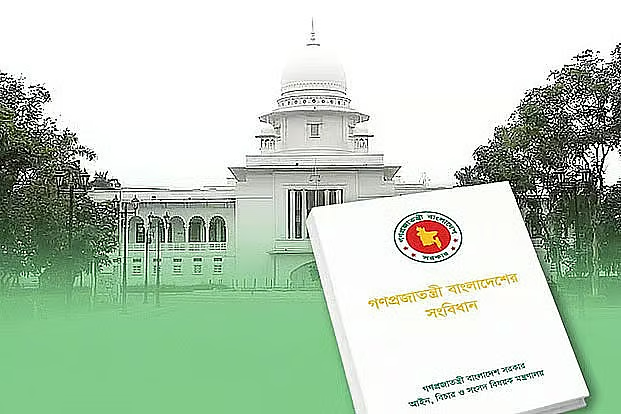
Bangladesh’s constitutional framework for the non-partisan caretaker government has been largely restored following a series of landmark Supreme Court decisions, but legal experts say several constitutional provisions still require amendment before the system can operate in its original form.
The caretaker government mechanism was first introduced through the Constitution’s Thirteenth Amendment on March 28, 1996, with the objective of ensuring free, fair, and impartial parliamentary elections. However, the system was abolished in 2011 after the Appellate Division declared the Thirteenth Amendment unconstitutional, a decision that was later reinforced by the Fifteenth Amendment to the Constitution.
Following the political changes after the July 2024 uprising, petitions were filed seeking a review of the earlier judgment. On November 20, 2025, the Appellate Division overturned its previous ruling and revived the constitutional provisions relating to the caretaker government. Subsequently, on July 9, 2026, the Appellate Division dismissed appeals challenging a High Court verdict that had struck down five provisions of the Fifteenth Amendment, further strengthening the legal basis for restoring the caretaker system.
Core Caretaker Provisions Restored
Legal experts say the Supreme Court’s rulings have effectively reinstated the Constitution’s key provisions governing the non-partisan caretaker government.
The High Court declared unconstitutional the sections of the Fifteenth Amendment that had removed Article 58A and Chapter IIA, both of which formed the constitutional foundation of the caretaker government. With the dismissal of the appeals, those provisions are set to return to the Constitution.
In its November 2025 judgment, the Appellate Division also revived Chapter IIA of the Constitution, which outlines the structure, authority, appointment process, and responsibilities of the caretaker government. The court stated that these revived provisions would apply prospectively, making them applicable to future parliamentary elections.
Constitutional lawyers believe this means the caretaker government framework could be used during Bangladesh’s next general election.
Several Constitutional Provisions Still Missing
Despite the restoration of the core caretaker government structure, several related constitutional provisions remain unchanged because they were not declared invalid by the courts.
Among the unresolved issues is Article 61 concerning the command of the armed forces. Before the Fifteenth Amendment, the Constitution stated that during the tenure of a caretaker government, the President would exercise authority over the armed forces under the relevant law. That wording has not been restored.
Another unresolved issue involves Article 99, which concerns retired judges. Under the original caretaker system, retired Chief Justices could serve as Chief Adviser. However, the Fifteenth Amendment imposed restrictions preventing retired judges from accepting certain state positions, and that provision remains in force. As a result, constitutional experts say retired judges could still face legal barriers to serving as Chief Adviser or Adviser under the caretaker government.
Election Timing Creates Constitutional Conflict
Lawyers have also pointed to a potential conflict involving Article 123 on the timing of parliamentary elections.
The Fifteenth Amendment requires elections to be held within the 90 days before Parliament’s term expires if dissolution occurs due to the end of its tenure. Under the original caretaker government framework, however, the caretaker administration would be formed only after Parliament was dissolved.
Legal analysts argue that these two provisions are difficult to reconcile because a caretaker government cannot be constituted before Parliament ceases to exist.
Oath, Definitions and Constitutional Protections Not Reinstated
Several supporting constitutional provisions associated with the caretaker government have also not been revived.
The constitutional forms for administering the oath of office to the Chief Adviser and Advisers, which had existed under the Thirteenth Amendment, remain absent. Likewise, constitutional definitions of “Chief Adviser” and “Adviser” were not restored.
Provisions relating to the remuneration and constitutional protections of the Chief Adviser and Advisers also remain excluded from the Constitution.
Experts Call for Parliamentary Action
Senior constitutional lawyers say that while the judiciary has restored the principal framework of the caretaker government, important legal inconsistencies remain.
According to legal experts, six caretaker-related provisions introduced or modified by the Fifteenth Amendment were not invalidated by the courts. As a result, issues involving election scheduling, appointment eligibility, oath-taking procedures, constitutional definitions, and remuneration still require legislative attention.
They believe these matters can only be fully resolved through constitutional amendments passed by Parliament. The detailed observations contained in the Appellate Division’s full judgment are also expected to clarify whether the court has provided guidance on addressing the remaining constitutional gaps.
Until then, while Bangladesh’s caretaker government system has been substantially revived, several legal and procedural issues remain unresolved before the framework can function exactly as it did prior to its abolition.


